
The Bing Webmaster Tools Duplicate-Title Problem (July 2026)
We caught bing.com shipping three back-to-back identical page titles on Friday. By Monday, Microsoft appears to have fixed it. The story is a masterclass in on-page SEO fundamentals — and why they still matter.
Updated Monday, July 20, 2026 — Microsoft appears to have addressed the duplicate-title issue we flagged Friday. The screenshot below shows the state of Google’s SERP on Jul 17. As of Jul 20, the titles now differentiate. We’re publishing anyway because the fundamentals it exposes are still worth talking about.
The screenshot that started this
On Friday, July 17, 2026, we searched Google for “bing webmaster tools.” The first three organic results were all from bing.com. All three carried the same page title: “Bing Webmaster Tools.” The meta descriptions were near-identical.
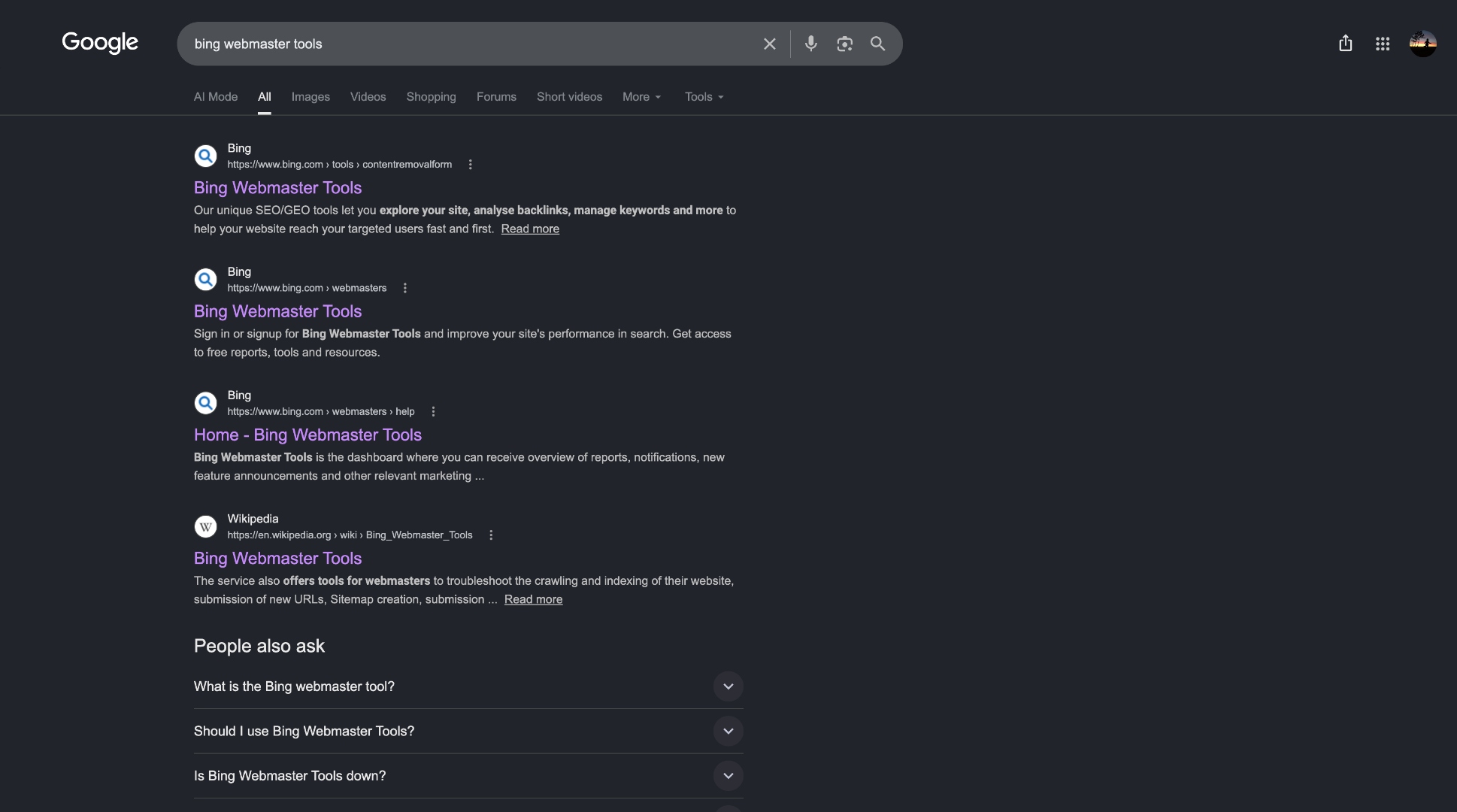
The tool Microsoft ships to help you fix your on-page SEO was, on Friday, failing the single most basic on-page SEO rule: every page needs a unique, keyword-specific title.
By Monday morning, July 20, the titles now differentiate on Google:
- “Bing Webmaster Tools” (
bing.com/webmaster/tools/contentremovalform) - “Home - Bing Webmaster Tools” (
bing.com/webmaster) - “Getting Started Checklist - Bing Webmaster Tools” (
bing.com/webmaster/help/getting-started-checklist)
Whether Google re-indexed after picking up a change on Microsoft’s end, or Google adjusted how it renders duplicate title clusters in the SERP, we can’t say from the outside. The fix is real either way.
Why this matters even when it’s fixed
Three points of value in the story:
The failure mode itself is one of the most common problems we find in AEO audits. Roughly 40% of the client sites we audit ship with 3+ pages sharing a duplicate or near-duplicate <title> tag. Even Microsoft’s own product page ran into it.
The fix happens fast when the site owner notices — often within a few days of an index update. That means the audit-to-recovery loop is tight, and the ROI on fixing your title tags this week is measurable this quarter.
AI answer engines penalize duplicate titles harder than Google does. Google shows a duplicate cluster and moves on. ChatGPT, Perplexity, Gemini, and Bing Copilot look at your site and cannot decide which page is the authoritative answer for a given prompt — so they often cite neither, or cite the third-party page (Wikipedia, in this case) instead of yours.
What actually goes wrong when your titles duplicate
SERP cannibalization
When multiple pages on your site compete for the same title, Google clusters them. One of the three “wins” the top slot; the other two are demoted, and click-through rate drops across the whole cluster. Your traffic isn’t lost — it’s split across pages that should have been distinct entry points.
AI answer engine confusion
Answer engines rely on the title tag as one of the primary signals for which page on a domain is the canonical answer to a given query. When titles collide, the engine either picks arbitrarily, picks nothing, or picks a third-party page like Wikipedia. This is the failure mode you never see reported in analytics — the citation you didn’t earn because the AI couldn’t tell your pages apart.
Meta description echo effect
Duplicate titles almost always ship alongside duplicate or near-duplicate meta descriptions. That doubles the confusion signal to both search engines and answer engines. The Friday screenshot showed all three descriptions leading with variants of “our unique SEO/GEO tools” — near-verbatim phrasing across three pages that serve different purposes (main tool, dashboard home, and content removal form).
How to audit your own site for the same problem
Five concrete steps. Should take about 30 minutes on a site under 500 pages.
1. Crawl your site with a tool that captures titles
Screaming Frog (free up to 500 URLs), Sitebulb, or Ahrefs Site Audit will export a CSV of every URL on your site with its current <title> value. If you use a CMS with a plugin (Yoast, RankMath, Astro’s @astrojs/seo), export the same data from the plugin’s title report.
2. Sort by title and look for exact matches
In the CSV, sort alphabetically by the Title column. Exact duplicates will surface immediately as adjacent rows. Every duplicate is a candidate for a rewrite.
3. Look for near-duplicates by first 30 characters
Add a helper column that extracts the first 30 characters of each title. Sort by that. Titles like “Best AEO Tools for…” repeated across five posts differ only by the suffix and will cluster the same way in AI answer engines. Rewrite them so the first 30 characters — the part users scan — differ meaningfully.
4. Check meta descriptions the same way
Same crawl usually exports meta descriptions. Repeat steps 2 and 3. If two pages share both title and description, they’re competing for the exact same query — one of them either needs a rewrite, a canonical tag, or removal.
5. Recheck in Google Search Console after 2 weeks
Once fixes are deployed, watch the “Performance > Pages” report for improved impressions and CTR on the rewritten URLs. The lift is typically visible within 10-21 days of the fix being indexed.
Microsoft’s recovery timeline is a data point
The screenshot was captured Friday afternoon. By Monday morning — approximately 60 hours later — the titles had differentiated. That’s a useful benchmark. If Microsoft can fix the underlying issue and get Google to re-render the SERP in a long weekend, your team can too.
Recovery is not the hard part. The hard part is knowing you have the problem in the first place. Most sites we audit have been shipping duplicate titles for months or years without noticing, because nobody was running the audit.
Frequently asked questions
What is a duplicate title tag and why does it hurt SEO?
A duplicate title tag is when two or more pages on the same site share an identical <title> element. This hurts SEO because search engines rely on the title as one of the strongest signals for what a page is about. When titles collide, Google clusters the pages, splits traffic, and often demotes the whole cluster. AI answer engines like ChatGPT and Perplexity are stricter — they may cite none of the affected pages and choose a third-party source instead.
How does Google handle duplicate titles from the same domain?
Google typically clusters same-domain results with duplicate titles and shows only 1-3 of them in the SERP, demoting the rest. In extreme cases Google will rewrite the title on the fly using page content, which produces unpredictable results in AI answer engines that pull from your intended title tag. The safest fix is to ship unique, descriptive titles from the source.
How is duplicate-title impact different for AI answer engines vs traditional SEO?
Traditional SEO downgrades the cluster but usually keeps at least one page ranking. AI answer engines are more binary. When a query matches multiple same-domain pages with identical titles, engines like Perplexity, ChatGPT, Gemini, and Bing Copilot often cannot identify a canonical answer — so they either cite a third-party source or skip the citation entirely. This is the invisible cost most sites never measure.
How do I check if my site has duplicate title tags?
Crawl the site with Screaming Frog (free up to 500 URLs), Sitebulb, or Ahrefs Site Audit. Export the URL and title columns to CSV. Sort by title and look for adjacent rows with identical values. For near-duplicates, extract the first 30 characters of each title and sort by that. Google Search Console also flags duplicate titles in the Coverage and Enhancements reports.
How long does it take to see improvement after fixing duplicate titles?
Typically 10 to 21 days for Google to re-index and reflect the change in Search Console performance reports. AI answer engines refresh their citation graphs on their own schedules — Bing Copilot and Perplexity are usually the fastest to pick up changes, followed by Google AI Overviews and ChatGPT. Microsoft’s own fix on the Bing Webmaster Tools pages appeared to propagate within about 60 hours.
Does WebbROI’s AEO audit check for this?
Yes. Every WebbROI AEO audit includes a full title-tag and meta-description uniqueness check across the client’s site, plus a review of how AI answer engines currently cite (or fail to cite) each of those pages. Duplicates surface immediately and are prioritized in the fix list by the impact-per-effort scoring we use.
Methodology & disclaimer
- Screenshot captured from Google’s SERP on Friday, July 17, 2026, at approximately 7:08 PM MDT, searching the query “bing webmaster tools” from a desktop browser in a US IP range.
- Recheck performed Monday, July 20, 2026, at approximately 9:00 AM EDT. Titles observed had differentiated per the SERP results reported in the body.
- Google’s exact re-rendering behavior and Microsoft’s exact fix (if any) cannot be verified from outside the two organizations. The observed change is a fact; the mechanism behind it is inference.
- WebbROI has no partnership with Microsoft or Bing. Bing Webmaster Tools is used by our team for its intended purpose (site verification, index inspection).
Sources
- Google Search Central — Title link best practices
- Microsoft Bing Webmaster Tools — Product page
- Ahrefs — Duplicate Content: An SEO Guide
- Perplexity — About Perplexity’s index (context on how AI engines resolve page identity)
Author: Taylor Miles, Founder, WebbROI. Published July 20, 2026.
If your site might have the same problem, our fixed-price AEO audit surfaces duplicate titles and meta descriptions along with the AI-citation impact of each. Turnaround is 5 business days.